Key takeaways
- An angle is the reason to buy that an ad leads with. The hook is how you open it, the format is how you show it.
- Angles fall into families: problems and results, proof, the product itself, comparison, objections, identity and story, and offers and timing.
- Cold audiences usually respond to problem, result and identity angles. Warm audiences respond to proof, objection and offer angles.
- Test angles before hooks and formats. A strong angle survives many executions, a weak one doesn't.
- Keep an angle bank with every angle you've tried, its best hook and its result.
An ad angle is the specific reason to buy that an ad leads with, such as saving time, a visible result, a trusted ingredient or a better price than the alternative. One product can be sold on dozens of angles, and each attracts different buyers. This library lists 48 angles for Facebook and Instagram, grouped by the job they do, each with an example line and when to use it.
What is an ad angle, and how is it different from a hook?
Three terms get mixed up constantly:
- Angle: the reason to buy. "It keeps coffee hot for six hours."
- Hook: the opening that earns attention for that reason. "My coffee was still steaming at 2pm."
- Format: how the ad is delivered. A static, a UGC video, a carousel, a catalog ad.
One angle can carry many hooks and many formats. That's why angles are the first thing to test. If an angle works, you can keep finding new hooks and formats for it for months. If it doesn't, no amount of hook polishing will save it. The Reels ad hooks guide covers hooks in detail, and the static vs video guide covers format choice.
The example lines below use a mix of product categories. They are illustrations to adapt, and every claim in a real ad must be true for your product.
Problem and result angles
These lead with the pain the buyer feels or the outcome they want. They are the workhorses of cold prospecting.
| # | Angle | Example line | When to use it |
|---|---|---|---|
| 1 | Problem-solution | "Tired of foundation sliding off by noon? This primer holds." | Default for cold audiences when the problem is common and felt |
| 2 | Agitate the problem | "That 3pm crash isn't about coffee. It's about breakfast." | When people tolerate the problem and need to feel it first |
| 3 | Dream outcome | "Wake up to skin that looks rested, even when you aren't." | Aspirational categories: beauty, fitness, home |
| 4 | Before and after | "Week one versus week six." | Visible results, and only where your category's policy allows it |
| 5 | Time saved | "Dinner on the table in 12 minutes, one pan." | Busy buyers, kitchen, cleaning, grooming |
| 6 | Money saved | "One refill pouch replaces four plastic bottles." | Repeat-purchase and replacement products |
| 7 | Effort removed | "No more ironing. Hang it up, the creases drop out." | Products that remove a chore |
| 8 | Hidden cause | "Dry hair often starts with your shampoo, not your hair." | When the buyer blames the wrong thing |
| 9 | Specific use case | "The bag that fits a 16-inch laptop and your gym kit." | Products with one standout situation |
| 10 | Avoid a bad outcome | "Don't find out your sunscreen was too thin at 3pm on the beach." | Protection, safety and insurance-like products |
Proof angles
Proof angles make a claim believable. They often work best on people who already know what you sell.
| # | Angle | Example line | When to use it |
|---|---|---|---|
| 11 | Customer review | "'I've bought this three times now.' Priya, Pune" | Any stage, real reviews only |
| 12 | Volume of buyers | "Join the customers who reorder every month." | When you have real, stated numbers you can back up |
| 13 | Star rating | "Rated 4.8 by verified buyers." | Warm audiences close to purchase, with an accurate, current figure |
| 14 | UGC testimonial | A customer talking to camera about their first month | Cold and warm, especially for new brands |
| 15 | Expert or professional | "Formulated with a dermatologist." | Health-adjacent categories, if true and permitted |
| 16 | Press or awards | "As featured in..." with the real outlet | Trust-building for higher prices, accurate claims only |
| 17 | Demonstration as proof | The pan releasing a fried egg with no oil | Products whose benefit is visible |
| 18 | Stress test | "We left it in a hot car for six hours." | Durability, insulation, waterproofing |
| 19 | Sold-out history | "Back in stock after selling out in March." | Products with genuine past demand |
| 20 | Repeat customers | "Most of our orders come from people who've ordered before." | Consumables, only with real data behind it |
Proof must be real. Invented reviews, fake ratings and made-up statistics break consumer law in many countries and Meta's advertising standards.
Product angles
These focus on what the product is and how it is made.
| # | Angle | Example line | When to use it |
|---|---|---|---|
| 21 | Hero ingredient | "Ashwagandha, sourced from a single farm in Rajasthan." | Beauty, wellness, food and drink |
| 22 | What's not in it | "No added sugar, no palm oil, nothing you can't pronounce." | Clean-label and sensitive-skin buyers |
| 23 | Craft and process | "Every candle is poured by hand and cured for two weeks." | Premium, handmade, artisanal |
| 24 | Material and quality | "Full-grain leather that softens instead of cracking." | Fashion, bags, footwear, furniture |
| 25 | Design detail | "A hidden pocket for your passport, right where your hand falls." | Products with one clever feature |
| 26 | Unboxing and packaging | "It arrives ready to give." | Gifting, premium packaging |
| 27 | Range and choice | "Twelve colours. Find yours." | Fashion, accessories, home, when choice is a benefit |
| 28 | How to use it | "Three ways to use one scarf." | Versatile products, and buyers unsure how to start |
Comparison angles
Comparison angles position the product against the alternative. Compare against a habit or category, not a named competitor, unless you have legal advice and evidence.
| # | Angle | Example line | When to use it |
|---|---|---|---|
| 29 | Us versus the old way | "Paper towels: a year's worth. This cloth: one." | Replacement products |
| 30 | Price per use | "Less than the price of a coffee a week." | Higher one-off prices that last a long time |
| 31 | Salon or shop alternative | "Salon-style blow-dry at home in ten minutes." | Products that replace a service |
| 32 | Good, better, best | "The everyday set, the travel set, the complete set." | Bundles and ranges |
| 33 | Honest trade-off | "It's not the cheapest. It's the last one you'll buy." | Premium positioning with a clear quality story |
Objection-busting angles
These answer the reason people don't buy. They are especially useful for retargeting and for products with a known doubt.
| # | Angle | Example line | When to use it |
|---|---|---|---|
| 34 | Price objection | "Why it costs more, and why people still buy it." | Premium products with real reasons |
| 35 | Will it work for me | "Made for curly, coily and wavy hair." | Products with fit or type concerns |
| 36 | Sizing and fit | "Not sure of your size? Free exchanges on every order." | Fashion and footwear, if your policy allows |
| 37 | Risk reversal | "Try it for 30 days. Not for you? Send it back." | Only if you genuinely offer it |
| 38 | Myth-busting | "Natural doesn't mean weak. Here's what's inside." | When a category belief holds people back |
| 39 | Delivery and trust | "Ships in 24 hours, tracked to your door." | New brands, cash-on-delivery markets, gifts |
Identity and story angles
These connect the product to who the buyer is or wants to be, or to the people behind it.
| # | Angle | Example line | When to use it |
|---|---|---|---|
| 40 | Founder story | "I started this after my daughter's eczema flared every winter." | New and small brands, any stage |
| 41 | Call-out a group | "For runners who hate chafing." | Cold prospecting with a clear niche |
| 42 | Values and mission | "Plastic-free, from the jar to the tape on the box." | Buyers who choose on values |
| 43 | Heritage and origin | "A family recipe from Kerala, unchanged for three generations." | Food, wellness, craft products |
Offer and timing angles
These give a reason to act now. They work best on audiences who already want the product.
| # | Angle | Example line | When to use it |
|---|---|---|---|
| 44 | Seasonal or event | "Diwali gifts that arrive in time." | Festive periods, gifting seasons, launches |
| 45 | Bundle value | "Buy two, get the third free." | Raising average order value |
| 46 | Limited stock or time | "Sale ends Sunday at midnight." | Genuine deadlines only |
| 47 | New launch | "New: the travel size you asked for." | Existing audiences and customers |
| 48 | Free shipping or gift | "Free shipping and a sample with every order this week." | Lowering the barrier on a first order |
That's 48 angles in total. Several overlap, which is fine. The point of a library is to give you starting points, not boxes to fit into.
Which angles suit cold and warm audiences?
A rough guide, based on how much the viewer already knows:
| Audience | Angles to try first | Why |
|---|---|---|
| Cold, never heard of you | Problem-solution, dream outcome, call-out, founder story, demonstration | They need a reason to care before a reason to trust |
| Engaged, has seen your ads | UGC testimonial, how to use it, hero ingredient, comparison | They're curious and want detail |
| Product viewers and cart abandoners | Reviews, objection-busting, delivery and trust, offer | They want it but something held them back |
| Past customers | New launch, bundle value, range, seasonal | They trust you and need a reason to return |
With broad targeting and Advantage+ audience, one prospecting ad set reaches people at every stage. Running several angles side by side lets Meta's delivery match each angle to the people most likely to respond.
How do you choose which angles to test first?
Start where you already have evidence:
- Read your reviews. The words customers use to praise the product are your best angle candidates. Repeated complaints point to objections worth answering.
- Check what competitors keep running. Ads that stay live for months in the Meta Ad Library are usually profitable. Note their angles, then express them in your own words and with your own product. The guide to Meta Ad Library competitor research shows how.
- Ask your support team. The questions people ask before buying are objections in disguise.
- Look at your best organic posts. What got saves, shares and comments?
- Pick three to five angles that are genuinely different, not three versions of the same idea.
Fly ROAS does part of this for you: it studies the long-running ads in your category in the Meta Ad Library, learns the hooks, layouts and angles that keep working, and builds new ads around them with your own brand and product photos rather than anyone else's creative.
How do you test ad angles?
Test the angle before you optimise the details.
- One angle per ad set in a testing campaign with ad set budgets, so each angle gets equal spend. The CBO vs ABO guide explains why that matters.
- Two or three executions per angle, for example a static and a short video, or two hooks. This stops one weak execution from killing a good angle.
- The same offer and landing page across angles, so the angle is the only big difference.
- Enough spend for a verdict, commonly two to three times your target CPA per ad. Work out that target with the CPA calculator.
- Judge on cost per purchase, with CTR and hook rate as early signals.
- Iterate on the winner. New hooks, new formats, new creators, same angle. The creative testing framework has a full process.
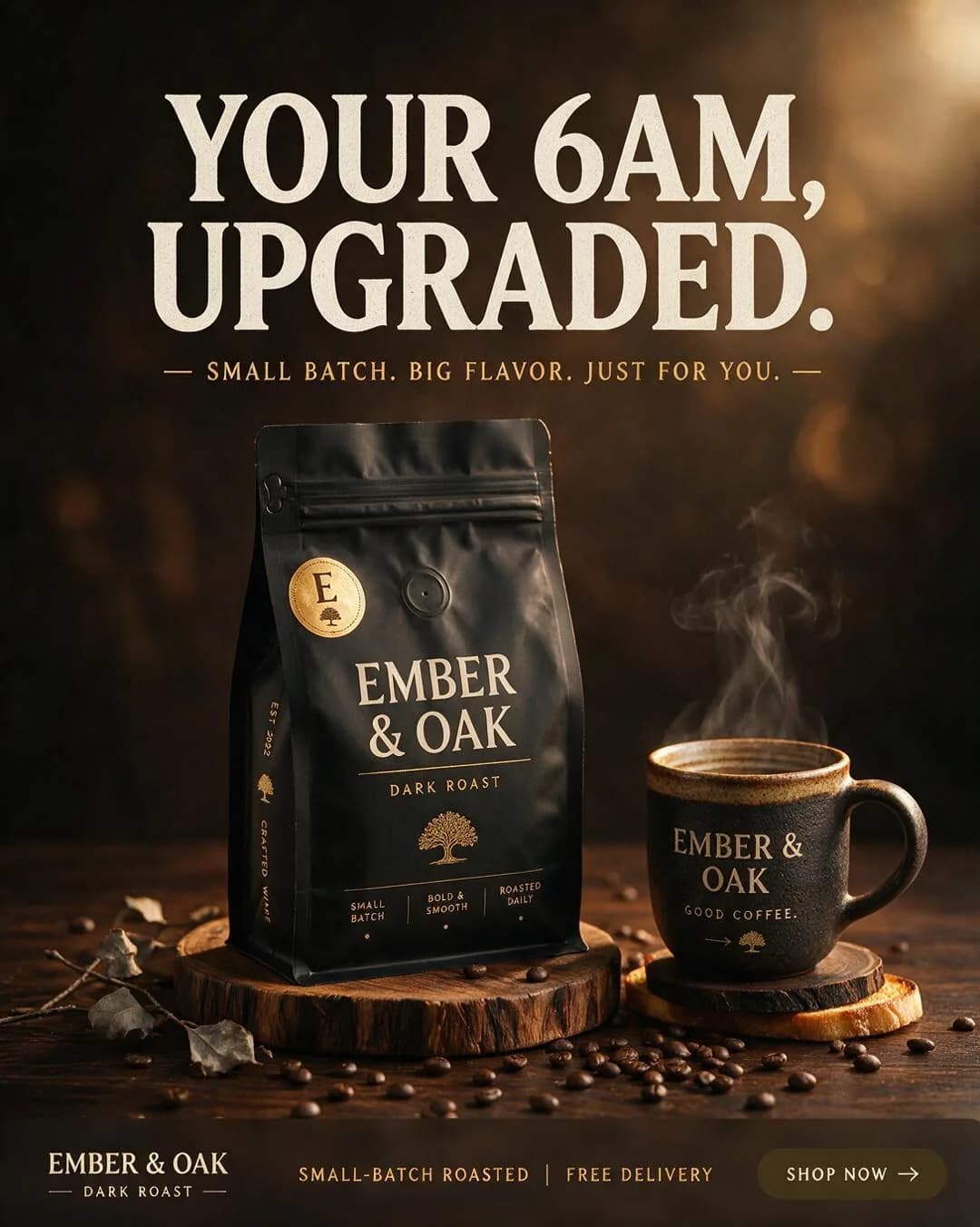
Worked example: angle test for a coffee brand
Say a coffee brand tests three angles with the same bundle offer, each with a static and a video, on equal budgets. Hypothetical results after a week:
| Angle | Best execution | Cost per purchase |
|---|---|---|
| Time saved: "Café coffee in 90 seconds" | Video | $22 |
| Hero ingredient: "Single-estate beans from Coorg" | Static | $35 |
| Price per use: "Less than a café latte a week" | Static | $28 |
Time saved wins clearly. The brand's next round tests four new hooks and a UGC version of that angle, while price per use gets one more try with a video before it is retired.
How do you keep an angle bank?
An angle bank is a simple log of every angle you've tested and what happened. A spreadsheet is enough. For each angle, record:
- The angle in one sentence
- The audience it was tested on
- The best hook and format
- Spend, purchases and cost per purchase
- The date and the verdict: winner, loser or inconclusive
- Ideas for the next test
Over a few months the bank shows which families of angles work for your brand. When a winning ad starts to tire, the bank tells you what to try next. The guide to ad fatigue explains when to refresh.
Angle testing checklist
- Each test ad set holds one angle
- Angles are genuinely different, not variations of one idea
- Every claim is true, specific and permitted in your category
- Offer and landing page are the same across the test
- At least two executions per angle
- Verdicts on cost per purchase after enough spend
- Results logged in the angle bank
Angles first, everything else second
The ad that wins isn't usually the one with the cleverest edit. It's the one with the right reason to buy, said clearly to the right people. Use this library as a starting list, test a few genuinely different angles, and spend your creative effort on the angles that earn it.
Frequently asked questions
What is an ad angle?
An ad angle is the main reason to buy that an ad leads with, such as saving time, a visible result, a trusted ingredient or a lower cost per use. It is different from the hook, which is how the ad opens, and the format, which is how the ad is shown.
How many ad angles should I test at once?
Three to five genuinely different angles is a practical range for most budgets, each in its own ad set with equal spend and two or three executions. Testing more at once usually spreads the budget too thinly to get clear verdicts.
Which ad angles work best for cold audiences?
Cold audiences often respond to angles that give them a reason to care: problem-solution, dream outcome, call-outs of a specific group, demonstrations and founder stories. Proof, objection and offer angles tend to work better on people who already know you.
Can I copy a competitor's ad angle?
You can learn from the angles competitors run, because an angle is an idea rather than a creative. Never copy their images, copy, logos or brand names. Express the angle in your own words, with your own product and proof.
How do I know when an ad angle has stopped working?
Watch cost per purchase across all the ads using that angle, not just one ad. If new hooks and formats on the same angle keep underperforming while other angles hold, the angle may be tired for that audience. Rest it and test new angles from your bank.